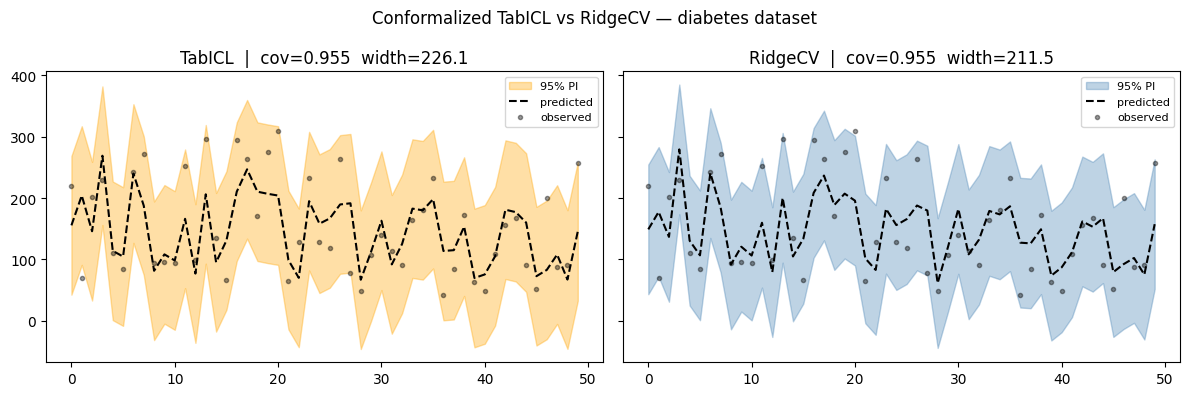
Il y a quelques jours, j’ai présenté Conformalized TabPFN : Intervalles de prédiction pour un transformateur pré-entraîné pour les données tabulaires en Python et R. Aujourd’hui, il s’agit de TabICL, un autre modèle de fondation tabulaire de pointe. TabICL ne nécessite aucun jeton, comme vous le remarquerez dans le code Python et R suivant.
!pip install tabicl nnetsauce # scikit-learn matplotlib numpy

from sklearn.datasets import load_diabetes
from sklearn.model_selection import train_test_split
from sklearn.linear_model import RidgeCV
from sklearn.metrics import mean_squared_error
from tabicl import TabICLRegressor
import nnetsauce as ns
import numpy as np
import matplotlib.pyplot as plt
from time import time

# ── data ───────────────────────────────────────────────────
X, y = load_diabetes(return_X_y=True)
X_train, X_test, y_train, y_test = train_test_split(
    X, y, test_size=0.2, random_state=42
)

# ── base models ────────────────────────────────────────────
models = {
    "TabICL": TabICLRegressor(),
    "RidgeCV": RidgeCV(),
}

results = {}
for name, reg in models.items():
    start = time()
    conf = ns.PredictionInterval(reg, level=95)
    conf.fit(X_train, y_train)
    pi = conf.predict(X_test, return_pi=True)
    print(f"{name:10s}  time={time() - start:.1f}s")

    coverage = np.mean((pi.lower <= y_test) & (pi.upper >= y_test))
    width    = np.mean(pi.upper - pi.lower)
    rmse     = np.sqrt(mean_squared_error(y_test, pi.mean))

    results[name] = {"pi": pi, "coverage": coverage,
                     "width": width, "rmse": rmse}
    print(f"{name:10s}  RMSE={rmse:.1f}  "
          f"coverage={coverage:.3f}  avg_width={width:.1f}")

# ── plot side-by-side ──────────────────────────────────────
fig, axes = plt.subplots(1, 2, figsize=(12, 4), sharey=True)
colors = {"TabICL": "orange", "RidgeCV": "steelblue"}
max_idx = 50

for ax, (name, res) in zip(axes, results.items()):
    pi = res["pi"]
    x  = range(max_idx)
    ax.fill_between(x, pi.lower[:max_idx], pi.upper[:max_idx],
                     alpha=0.35, color=colors[name], label="95% PI")
    ax.plot(x, pi.mean[:max_idx], "k--", lw=1.5, label="predicted")
    ax.plot(x, y_test[:max_idx], "k.", ms=6, alpha=0.4, label="observed")
    ax.set_title(
        f"{name}  |  cov={res['coverage']:.3f}  width={res['width']:.1f}"
    )
    ax.legend(fontsize=8)

plt.suptitle("Conformalized TabICL vs RidgeCV — diabetes dataset")
plt.tight_layout()
plt.show()

Checkpoint 'tabicl-regressor-v2-20260212.ckpt' not cached.
 Downloading from Hugging Face Hub (jingang/TabICL).


tabicl-regressor-v2-20260212.ckpt:   0%|          | 0.00/114M [00:00<?, ?B/s]


TabICL      time=21.8s
TabICL      RMSE=54.4  coverage=0.955  avg_width=226.1
RidgeCV     time=0.0s
RidgeCV     RMSE=53.9  coverage=0.955  avg_width=211.5

 %load_ext rpy2.ipython # in a Colab notebook, use this

%R install.packages("reticulate")

%%R  # in Colab/Jupyter with rpy2; remove this line for pure R

library(reticulate)

# pip install tabicl nnetsauce scikit-learn matplotlib numpy

sklearn_ds  <- import("sklearn.datasets")
sklearn_ms  <- import("sklearn.model_selection")
sklearn_m   <- import("sklearn.metrics")
sklearn_lm  <- import("sklearn.linear_model")
tabicl      <- import("tabicl")
ns          <- import("nnetsauce")
np          <- import("numpy")
plt         <- import("matplotlib.pyplot")

# ── data ───────────────────────────────────────────────────
d       <- sklearn_ds$load_diabetes(return_X_y = TRUE)
X <- d[[1]]; y <- d[[2]]
sp      <- sklearn_ms$train_test_split(X, y,
             test_size = 0.2, random_state = 42L)
X_train <- sp[[1]]; X_test <- sp[[2]]
y_train <- sp[[3]]; y_test <- sp[[4]]

# ── helper: fit + evaluate ─────────────────────────────────
eval_model <- function(reg, name) {
  conf <- ns$PredictionInterval(reg, level = 95L)
  conf$fit(X_train, y_train)
  pi   <- conf$predict(X_test, return_pi = TRUE)

  cov  <- np$mean((pi$lower <= y_test) * (pi$upper >= y_test))
  wid  <- np$mean(pi$upper - pi$lower)
  rmse <- sqrt(sklearn_m$mean_squared_error(y_test, pi$mean))

  cat(sprintf("%-10s  RMSE=%.1f  coverage=%.3f  avg_width=%.1f\n",
              name, rmse, cov, wid))
  invisible(pi)
}

# ── run both models ────────────────────────────────────────
pi_tabicl  <- eval_model(tabicl$TabICLRegressor(),  "TabICL")
pi_ridge   <- eval_model(sklearn_lm$RidgeCV(),       "RidgeCV")

# ── plot ───────────────────────────────────────────────────
max_idx <- 50L
x_range <- np$array(0:(max_idx - 1))

plot_pi <- function(pi, title, col) {
  x_fill <- np$concatenate(list(x_range, x_range[max_idx:1]))
  y_fill <- np$concatenate(list(
    pi$upper[1:max_idx], pi$lower[max_idx:1]))
  plt$fill(x_fill, y_fill, alpha=0.35, fc=col, ec="None", label="95% PI")
  plt$plot(x_range, pi$mean[1:max_idx], "k--", lw=1.5, label="predicted")
  plt$plot(x_range, y_test[1:max_idx], "k.", ms=6L, alpha=0.4, label="observed")
  plt$title(title); plt$legend(fontsize=8L)
}

fig <- plt$figure(figsize=c(12, 4))
plt$subplot(1L, 2L, 1L); plot_pi(pi_tabicl, "Conformalized TabICL", "orange")
plt$subplot(1L, 2L, 2L); plot_pi(pi_ridge,  "Conformalized RidgeCV", "steelblue")
plt$suptitle("Conformalized TabICL vs RidgeCV — diabetes dataset")
plt$tight_layout()
plt$show()

    WARNING: The R package "reticulate" only fixed recently
    an issue that caused a segfault when used with rpy2:

    Make sure that you use a version of that package that includes
    the fix.
    TabICL      RMSE=54.4  coverage=0.955  avg_width=226.1
RidgeCV     RMSE=53.9  coverage=0.955  avg_width=211.5


Probablement un ensemble de données qui l’est aussi facile pour un transformateur. La conformation de modèles simples leur permet, en général, d’obtenir des taux de couverture proches du niveau nominal, comme on le voit ici pour RidgeCV.
En rapport
PakarPBN
A Private Blog Network (PBN) is a collection of websites that are controlled by a single individual or organization and used primarily to build backlinks to a “money site” in order to influence its ranking in search engines such as Google. The core idea behind a PBN is based on the importance of backlinks in Google’s ranking algorithm. Since Google views backlinks as signals of authority and trust, some website owners attempt to artificially create these signals through a controlled network of sites.
In a typical PBN setup, the owner acquires expired or aged domains that already have existing authority, backlinks, and history. These domains are rebuilt with new content and hosted separately, often using different IP addresses, hosting providers, themes, and ownership details to make them appear unrelated. Within the content published on these sites, links are strategically placed that point to the main website the owner wants to rank higher. By doing this, the owner attempts to pass link equity (also known as “link juice”) from the PBN sites to the target website.
The purpose of a PBN is to give the impression that the target website is naturally earning links from multiple independent sources. If done effectively, this can temporarily improve keyword rankings, increase organic visibility, and drive more traffic from search results.