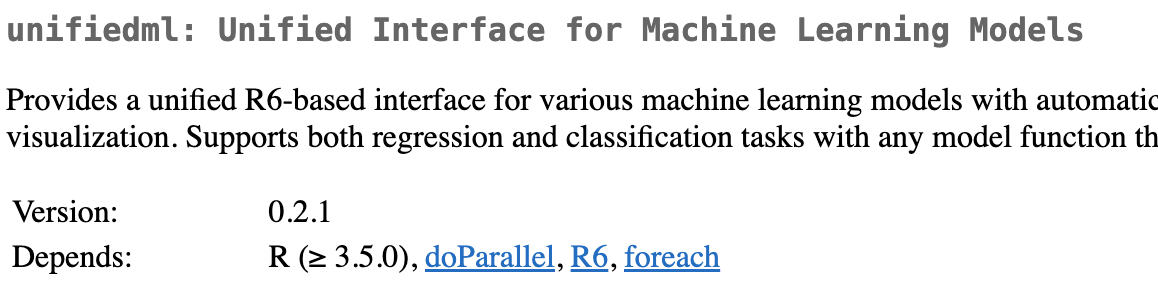
Une nouvelle version de unifiedml est sorti ; disponible sur CRAN. unifiedml est un effort visant à offrir une interface unifiée aux modèles d’apprentissage automatique de R.
Le principal changement dans cette version 0.2.1 est la suppression de type (de prédiction) de predictet l’utilisation de... au lieu de cela, ce qui est plus générique et flexible.
Cet article contient des exemples avancés d’utilisation de unifiedml pour le classementavec ranger et xgboost. D’autres exemples ont également été ajoutés aux vignettes du package.
install.packages("unifiedml")

install.packages(c("ranger"))

library("unifiedml")

Loading required package: doParallel

Loading required package: foreach

Loading required package: iterators

Loading required package: parallel

Loading required package: R6
library(ranger)


# 2 - 'ranger' classification ---------------------------

# -------------------------------
# S3 wrapper for ranger
# -------------------------------

# Fit function remains the same
my_ranger <- function(x, y, ...) {
  if (!is.data.frame(x)) x <- as.data.frame(x)
  y <- as.factor(y)
  colnames(x) <- paste0("X", seq_len(ncol(x)))
  df <- data.frame(y = y, x)
  fit <- ranger::ranger(y ~ ., data = df, probability = TRUE, ...)
  structure(list(fit = fit), class = "my_ranger")
}

# Predict only with newdata
predict.my_ranger <- function(object, newdata = NULL, newx = NULL, ...) {
  if (!is.null(newx)) newdata <- newx
  if (is.null(newdata)) stop("No data provided for prediction")
#  misc::debug_print(newx)
#  misc::debug_print(newdata)
  if (is.matrix(newdata)) newdata <- as.data.frame(newdata)
#  misc::debug_print(newdata)
  # Unconditionally rename to match training
  colnames(newdata) <- paste0("X", seq_len(ncol(newdata)))
#  misc::debug_print(newdata)
  preds <- predict(object$fit, data = newdata)$predictions
#  misc::debug_print(newdata)
  if (is.matrix(preds) && ncol(preds) == 2) {
    lvls <- colnames(preds)
    return(ifelse(preds[, 2] > 0.5, lvls[2], lvls[1]))
  }

  preds
}

# Print method
print.my_ranger <- function(x, ...) {
  cat("my_ranger model\n")
  print(x$fit)
}

# -------------------------------
# Example: Iris binary classification
# -------------------------------

set.seed(123)
iris_binary <- iris[iris$Species %in% c("setosa", "versicolor"), ]
X_binary <- iris_binary[, 1:4]
y_binary <- as.factor(as.character(iris_binary$Species))

# Train/test split
train_idx <- sample(seq_len(nrow(X_binary)), size = 0.7 * nrow(X_binary))
X_train <- X_binary[train_idx, ]
y_train <- y_binary[train_idx]
X_test <- X_binary[-train_idx, ]
y_test <- y_binary[-train_idx]

# Initialize and fit model
# Initialize model
mod <- Model$new(my_ranger)

# Fit on training data only
mod$fit(X_train, y_train, num.trees = 150L)

# Predict on test set
preds <- mod$predict(X_test)

# Evaluate
table(Predicted = preds, True =y_test)
mean(preds == y_test)  # Accuracy


# 5-fold cross-validation on training set
cv_scores <- cross_val_score(
  mod,
  X_train,
  y_train,
  num.trees = 150L,
  cv = 5L
)

cv_scores
mean(cv_scores)  # average CV accuracy


            True
Predicted    setosa versicolor
  setosa         15          0
  versicolor      0         15
1
|======================================================================| 100%
- 1
- 1
- 1
- 1
- 1
1
library(xgboost)

my_xgboost <- function(x, y, ...) {

  # Convert to matrix safely
  if (!is.matrix(x)) {
    x <- as.matrix(x)
  }

  # Handle factors
  if (is.factor(y)) {
    y <- as.numeric(y) - 1
  }

  fit <- xgboost::xgboost(
    data = x,
    label = y,
    ...
  )

  structure(list(fit = fit), class = "my_xgboost")
}

predict.my_xgboost <- function(object, newdata, ...) {

  # Ensure matrix
  newdata <- as.matrix(newdata)

  preds <- predict(object$fit, newdata)

  # If binary classification → convert probs to class
  if (!is.null(object$fit$params$objective) &&
      grepl("binary", object$fit$params$objective)) {

    return(ifelse(preds > 0.5, 1, 0))
  }

  preds
}

predict.my_xgboost <- function(object, newdata = NULL, newx = NULL, ...) {

  # Accept both conventions
  if (!is.null(newx)) {
    newdata <- newx
  }

  newdata <- as.matrix(newdata)

  preds <- predict(object$fit, newdata)

  # Binary classification → class labels
  if (!is.null(object$fit$params$objective) &&
      grepl("binary", object$fit$params$objective)) {

    return(ifelse(preds > 0.5, 1, 0))
  }

  preds
}

print.my_xgboost <- function(x, ...) {
  cat("my_xgboost model\n")
  print(x$fit)
}


set.seed(123)  # for reproducibility

# Binary subset
iris_binary <- iris[iris$Species %in% c("setosa", "versicolor"), ]
X_binary <- as.matrix(iris_binary[, 1:4])
y_binary <- as.factor(as.character(iris_binary$Species))

# Split indices: 70% train, 30% test
train_idx <- sample(seq_len(nrow(X_binary)), size = 0.7 * nrow(X_binary))
X_train <- X_binary[train_idx, ]
y_train <- y_binary[train_idx]
X_test <- X_binary[-train_idx, ]
y_test <- y_binary[-train_idx]

# Initialize model
mod <- Model$new(my_xgboost)

# Fit on training data only
mod$fit(X_train, y_train, nrounds = 50, objective = "binary:logistic")

# Predict on test set
preds <- mod$predict(X_test)

# Evaluate
table(Predicted = preds, True =y_test)
mean(preds == y_test)  # Accuracy


# 5-fold cross-validation on training set
cv_scores <- cross_val_score(
  mod,
  X_train,
  y_train,
  nrounds = 50,
  objective = "binary:logistic",
  cv = 5L
)

cv_scores
mean(cv_scores)  # average CV accuracy

En rapport
PakarPBN
A Private Blog Network (PBN) is a collection of websites that are controlled by a single individual or organization and used primarily to build backlinks to a “money site” in order to influence its ranking in search engines such as Google. The core idea behind a PBN is based on the importance of backlinks in Google’s ranking algorithm. Since Google views backlinks as signals of authority and trust, some website owners attempt to artificially create these signals through a controlled network of sites.
In a typical PBN setup, the owner acquires expired or aged domains that already have existing authority, backlinks, and history. These domains are rebuilt with new content and hosted separately, often using different IP addresses, hosting providers, themes, and ownership details to make them appear unrelated. Within the content published on these sites, links are strategically placed that point to the main website the owner wants to rank higher. By doing this, the owner attempts to pass link equity (also known as “link juice”) from the PBN sites to the target website.
The purpose of a PBN is to give the impression that the target website is naturally earning links from multiple independent sources. If done effectively, this can temporarily improve keyword rankings, increase organic visibility, and drive more traffic from search results.