Vous souhaitez partager votre contenu sur R-bloggers ? cliquez ici si vous avez un blog, ou ici si vous n’en avez pas.
Republié à partir de l’original sur https://blog.stephenturner.us/p/ctrlvee-extract-external-r-code-insert-inline-positron-rstudio-addin.
Vous êtes-vous déjà retrouvé à parcourir une page pkgdown ou un livre Quarto, à copier et coller des morceaux de code de votre navigateur dans votre IDE ? Oui, et c’est un désagrément mineur.
Mon ami et collègue VP Nagraj a publié un nouveau package R appelé ctrlvee cela rend les choses beaucoup plus faciles.
Cela fait une chose. Placez votre curseur n’importe où dans un script R dans Positron ou RStudio, appelez le complément, fournissez une URL et quelques millisecondes plus tard, vous aurez tout le code de cette page dans votre éditeur, séparé par des limites de morceaux (avec quelques métadonnées et une note à vérifiez la licence!).
Le package README fournit une démonstration utilisant le chapitre « Validation des données et assurance qualité » de mon Formation de l’équipe de science des données livre (dstt.stephenturner.us).
-
Installez le paquet :
install.packages("ctrlvee") -
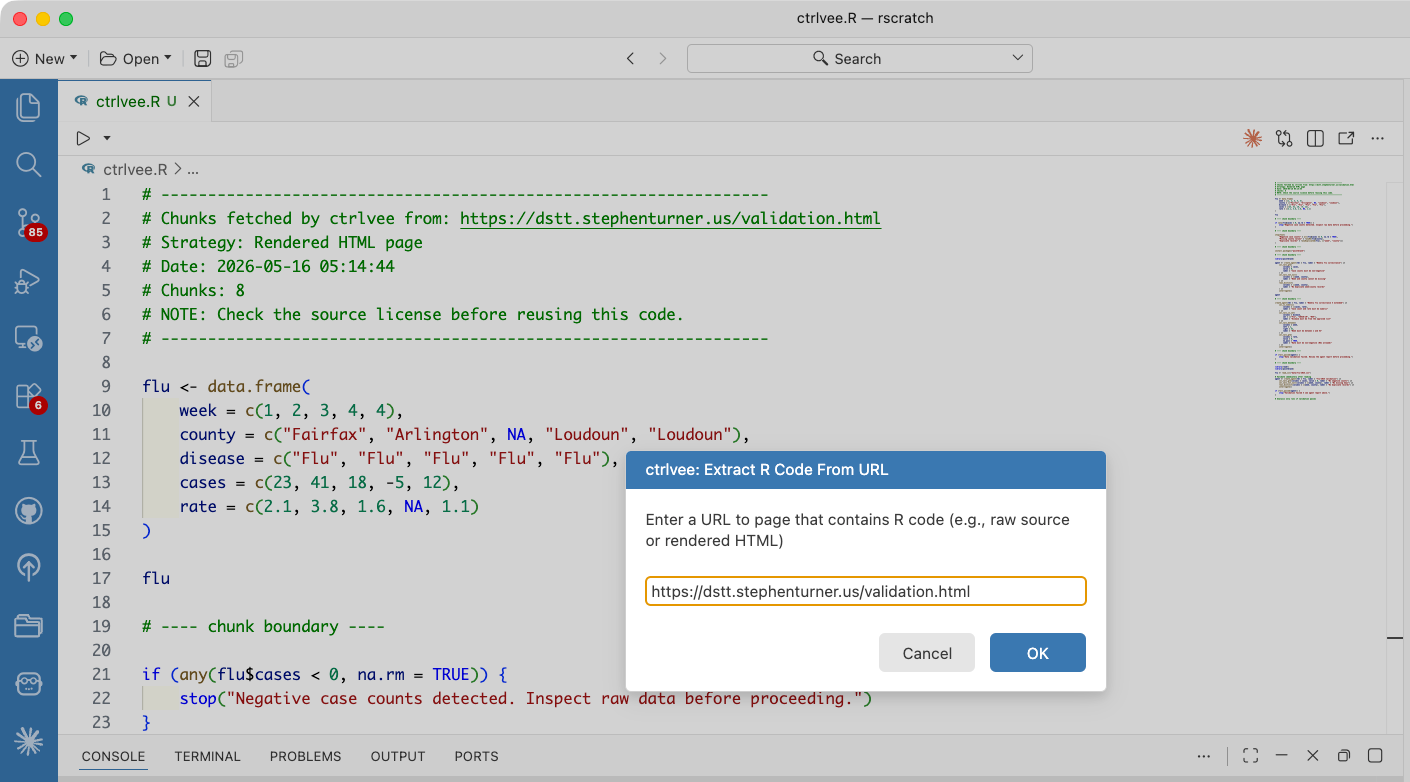
Exécutez le complément. Dans Positron, vous ouvrirez la palette de commandes, recherchez Run RStudio Addin, puis extraire le code R externe et l’insérer en ligne. Vous recevrez un modal vous demandant une URL.
-
Collez-en un. Par exemple,
-
Le code R du site apparaît dans votre éditeur 🚀
Voici une démo.
Voici à quoi ressemble le code extrait/inséré, de cette source.
# -----------------------------------------------------------------
# Chunks fetched by ctrlvee from:
# Strategy: Rendered HTML page
# Date: 2026-05-16 05:14:44
# Chunks: 8
# NOTE: Check the source license before reusing this code.
# -----------------------------------------------------------------

flu <- data.frame(
    week = c(1, 2, 3, 4, 4),
    county = c("Fairfax", "Arlington", NA, "Loudoun", "Loudoun"),
    disease = c("Flu", "Flu", "Flu", "Flu", "Flu"),
    cases = c(23, 41, 18, -5, 12),
    rate = c(2.1, 3.8, 1.6, NA, 1.1)
)

flu

# ---- chunk boundary ----

if (any(flu$cases < 0, na.rm = TRUE)) {
    stop("Negative case counts detected. Inspect raw data before proceeding.")
}

# ---- chunk boundary ----

stopifnot(
    "Negative case counts" = all(flu$cases >= 0, na.rm = TRUE),
    "Missing county values" = !anyNA(flu$county),
    "Duplicate records" = !anyDuplicated(flu[, c("week", "county")])
)

# ---- chunk boundary ----

install.packages("pointblank")

# ---- chunk boundary ----

library(pointblank)

agent <- create_agent(tbl = flu, label = "Weekly flu surveillance") |>
    col_vals_gte(
        columns = cases,
        value = 0,
        label = "Case counts must be non-negative"
    ) |>
    col_vals_not_null(
        columns = c(week, county),
        label = "Week and county cannot be missing"
    ) |>
    rows_distinct(
        columns = c(week, county),
        label = "No duplicate week/county records"
    ) |>
    interrogate()

agent

# ---- chunk boundary ----

create_agent(tbl = flu, label = "Weekly flu surveillance — extended") |>
    col_is_numeric(
        columns = c(cases, rate),
        label = "Case count and rate must be numeric"
    ) |>
    col_vals_in_set(
        columns = disease,
        set = c("Flu", "COVID-19", "RSV"),
        label = "Disease must be from the approved list"
    ) |>
    col_vals_between(
        columns = week,
        left = 1,
        right = 52,
        label = "Week must be between 1 and 52"
    ) |>
    col_vals_gte(
        columns = rate,
        value = 0,
        na_pass = TRUE,
        label = "Rate must be non-negative (NAs allowed)"
    ) |>
    interrogate()

# ---- chunk boundary ----

if (!all_passed(agent)) {
    stop("Data validation failed. Review the agent report before proceeding.")
}

# ---- chunk boundary ----

library(readr)
library(pointblank)

flu <- read_csv("data/flu-2024.csv")

# Validate immediately after reading
agent <- create_agent(tbl = flu, label = "flu-2024 validation") |>
    col_vals_gte(columns = cases, value = 0, label = "No negative counts") |>
    col_vals_not_null(columns = c(week, county), label = "No missing keys") |>
    rows_distinct(columns = c(week, county), label = "No duplicate records") |>
    interrogate()

if (!all_passed(agent)) {
    stop("Validation failed — see agent report above.")
}
En rapport
PakarPBN
A Private Blog Network (PBN) is a collection of websites that are controlled by a single individual or organization and used primarily to build backlinks to a “money site” in order to influence its ranking in search engines such as Google. The core idea behind a PBN is based on the importance of backlinks in Google’s ranking algorithm. Since Google views backlinks as signals of authority and trust, some website owners attempt to artificially create these signals through a controlled network of sites.
In a typical PBN setup, the owner acquires expired or aged domains that already have existing authority, backlinks, and history. These domains are rebuilt with new content and hosted separately, often using different IP addresses, hosting providers, themes, and ownership details to make them appear unrelated. Within the content published on these sites, links are strategically placed that point to the main website the owner wants to rank higher. By doing this, the owner attempts to pass link equity (also known as “link juice”) from the PBN sites to the target website.
The purpose of a PBN is to give the impression that the target website is naturally earning links from multiple independent sources. If done effectively, this can temporarily improve keyword rankings, increase organic visibility, and drive more traffic from search results.